Colored Lens Glasses – Which Tint Does What?
Colored lens glasses are, first of all, just that: glasses with tinted lenses that color incoming light differently than a grey or brown pair of sunglasses. What happens next is easy to observe – the whole environment takes on a mood, as if someone had shifted the white balance. Whether that becomes more than an optical effect is the question behind most searches for "colored glasses", "color therapy glasses" or "tinted lenses effect".
This guide answers it as honestly as we can: with what is measured, with what is experience, and with a clear line between the two. BERLINEON has been making colored lens glasses in Berlin since 2011 – so yes, we have an opinion. But we sell a tool for perception, not a remedy.
The four colors – and what we assign to them
In the reading BERLINEON has worked with since 2011, each lens color stands for a state. This mapping comes from 111+ wearers and our own observation – it is not a standard and not a proof. More on that on the page about research and evidence.
| Lens color | State in our reading | Typical moment |
|---|---|---|
| Green | Balance & inner calm | Walk, break, evening |
| Magenta | Creativity & power | Studio, stage, new start |
| Violet | Focus & clarity | Desk, concept, deep work |
| Sky blue | Serenity & overview | Planning, conversation, wide view |
Combining two of these colors in one frame – one on the left, the other on the right – is what we call Stereo Chrome. How it feels and why both eyes don't argue about it is explained on Stereo Chrome: two colors, one pair.
What colored lenses reliably do
Three things are undisputed and can be checked with any tinted pair:
- They shift the spectrum. A green lens lets green wavelengths through and dampens red and blue. The world looks the way the lens filters it.
- They change contrast. Yellow and orange lenses raise contrast in dull light; blue and violet tend to lower it. Cyclists, shooters and pilots have used this for decades.
- They carry a message. Colored glasses on a face are visible. They say something about the person wearing them – and that changes how others respond.
What colored lenses do not reliably do: produce a specific mood. That warm hues are generally perceived as more pleasant than cool ones is well documented. That a pair with a warm lens turns this into a good mood on demand is not. Psychologist Hans Irtel put it briefly in an interview with TOUR magazine: "It is not only about the color."
How to recognize a good pair
The lens color says nothing about UV protection. A dark lens without a UV filter is worse than no glasses at all, because the pupil widens and lets more UV light into the eye. So, whatever the color:
- UV400 or "100 % UV protection" must be stated – not just a CE mark.
- Tint strength suited to the use: light tint for indoors and evenings, medium for the city and everyday wear.
- A frame that survives the day: acetate instead of injection molding, adjustable nose pads, temples that can be fitted.
- Advice before buying, because you have to wear a color to know whether it fits you – if unsure, ask first.
The full checklist with prices, model comparison and the difference between a 12-euro set and a handmade pair is in the buying guide.
Entry: one pair, two colors, €111.11
If you are wearing colored lenses for the first time, don't start with the most intense color. Our entry model combines sky blue and green – the two calmest tones – in a Stereo Chrome frame:
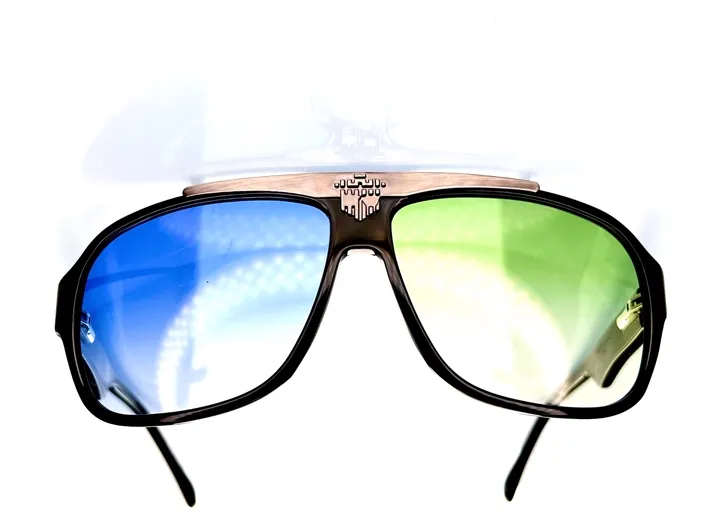 AyurvedaSky blue + green · Stereo Chrome · entry model€111.11 · view →
If you'd rather begin with a single warm color, there is the rosé version at the same price:
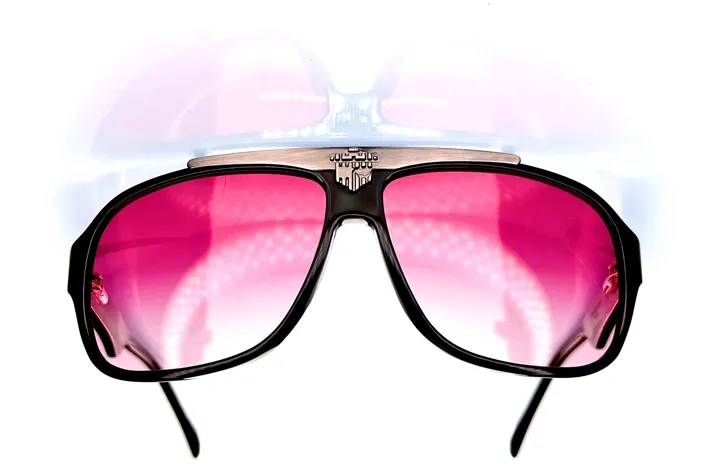 Pinky Blinders / LovebirdRosé · single color · warm and light€111.11 · view →
Both pairs are hand-numbered, made in Berlin, with UV400 lenses and a frame of plant-based acetate. Questions about the right model: FAQ or simply write to us.