
Tinted Lenses – Effects and Research
Search for "tinted lenses effect" and you get two kinds of answers: sellers who promise everything, and opticians who reduce everything to contrast and glare. Both fall short. Here is an attempt to sort the picture into three levels – measured, plausible, experience – so it is clear where colored lens glasses stand, and where they don't.
Level 1: what is measured
Spectrum and contrast. That a colored lens transmits certain wavelengths and dampens others is physics, specified by every lens manufacturer. It follows directly: yellow and orange tints raise contrast in diffuse light, grey leaves colors largely unchanged, blue and violet tints tend to lower contrast sensitivity. This is why sports optics has worked with lens colors for decades and why consumer sites such as ZDFheute recommend grey lenses for driving.
UV protection is independent of color. An important, often overlooked point: the UV filter sits in the material or in a coating, not in the tint. A pale pink lens can be UV400; a deep black one may not be. Without a filter, the pupil widens behind a dark lens and more UV light reaches the retina.
Visual behavior under color filters. A doctoral thesis at the University of Tübingen examined how colored lenses influence contrast sensitivity, accommodation and physiological arousal – measurable quantities, not feelings (Effects of color-tinted lenses on visual behavior). The work confirms that color filters change visual behavior; it makes no claim of the kind "color X makes you happy".
Level 2: what is plausible
Color and mood are linked – through association. That many people find warm hues more pleasant than cool ones is well described in the psychology of perception. Psychologist Hans Irtel explains in TOUR magazine that a filter shifts the perceived color distribution of the whole environment and can thereby influence mood – adding that it is not only about the color. The effect runs through personal association, context and expectation, not through a direct switch in the brain.
Manufacturers go a step further. ZEISS markets a lens series called BioChrom that, according to the maker, is meant to influence mood, brain activity and performance. The underlying research is described in general terms but not disclosed. That is not an accusation, just a classification: it is a manufacturer's statement, not an independent finding.
What is not plausible: the promises of many cheap "chakra" or "color therapy" glasses that assign each color a fixed physical or emotional effect. There is no solid basis for that, and the products themselves are generally not approved as medical devices – rightly so.
Level 3: what is experience
BERLINEON has worked with four lens colors since 2011 and assigns them states: green for balance, magenta for creativity, violet for focus, sky blue for overview. This mapping grew out of more than 111 wearers and an ongoing self-experiment we document in the Highwear pre-paper. It is experience, not proof – and we prefer to say that ourselves rather than have someone else say it.
What we observe consistently:
- The effect is strongest in the first minutes, when the environment "tips". After that, vision adapts and the color becomes a background mood rather than a stimulus.
- Switching between two colors is more noticeable than one color alone. That is why our models are either Stereo Chrome (two colors in one frame) or designed as an interchangeable system.
- The effect on others is real: whoever wears colored glasses is approached differently. Whether that lifts the mood depends on the person.
What this means for buying
Colored lens glasses are not a remedy and not a medical device. They are a tool for deliberately coloring your own perception – and honestly, they work best where you use them as a ritual: glasses on, state changed. If you want to try that, start with a calm combination:
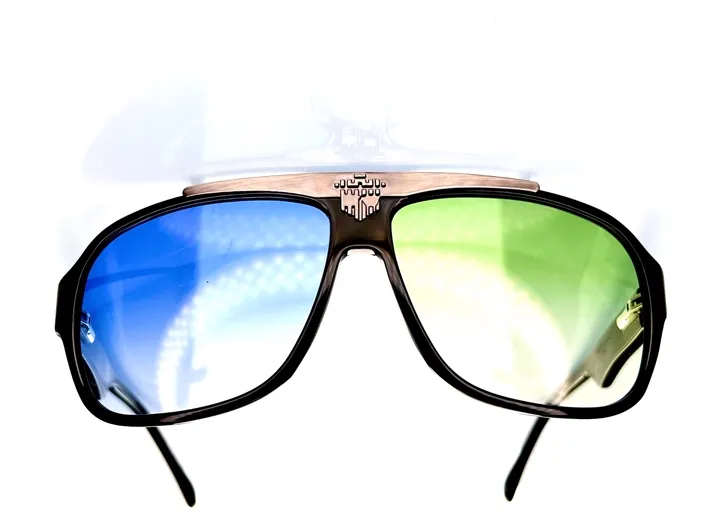 AyurvedaSky blue + green · Stereo Chrome · entry model€111.11 · view →
If you want the strongest switch, take the original with magenta and green:
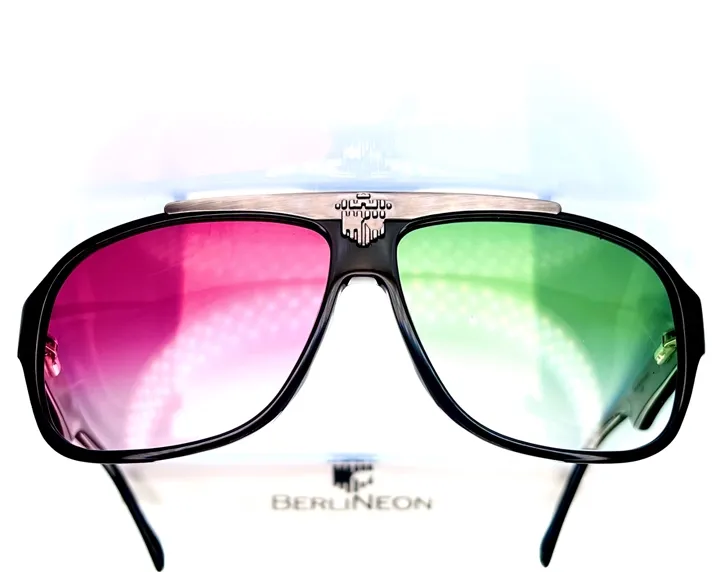 Stereo LoveMagenta + green · the original since 2011€222.22 · view →
Back to the overview or on to the buying guide.